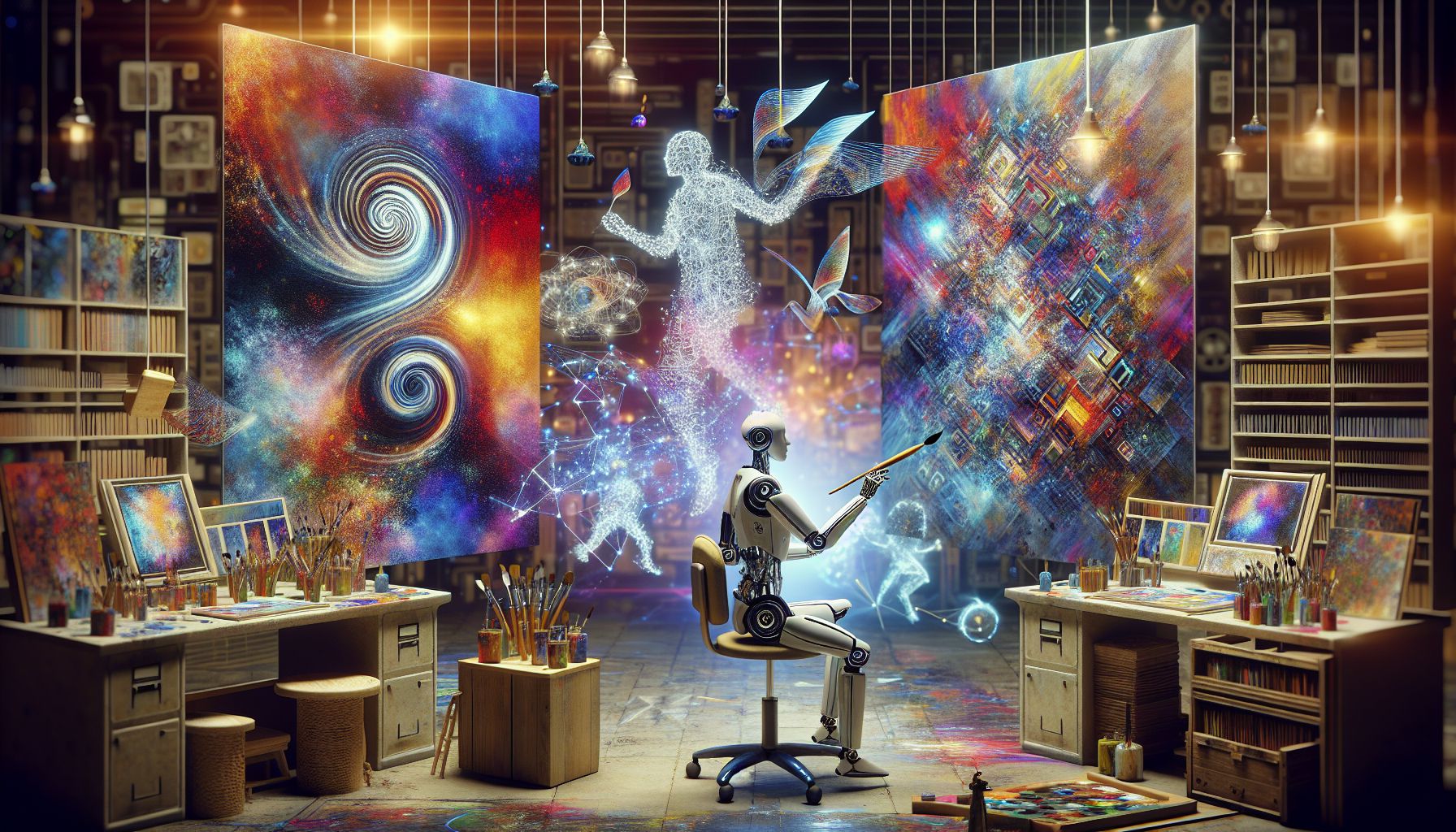
Welcome back, tech explorers! It’s another sunny day in silicon land, and I’ve got a tale straight out of the digital renaissance. Today, we’re diving into the mesmerizing world where Artificial Intelligence shakes hands with the creative arts. We’re talking about AI not just creating art but redefining it—a slippery blend of pixels and creativity that’s both awe-inspiring and just a little bit eerie. So grab your digital paintbrush or maybe just a comfy chair—let’s explore this brave new world together!
Art and AI: A Modern Love Story
So, here’s the scoop: AI’s getting artsy, my friends. Everywhere you turn, there seems to be an algorithm dabbling in the arts. From painting and composing symphonies to writing poems and screenplays, the creative domain is alive with the hum of machine learning. But how did we get here? Is this truly innovation, or just a high-tech flash in the pan?
The Glimpse Isn’t Just a Glitch
Let’s roll back a bit. The partnership between AI and art isn’t brand new—it’s been brewing for a few years now. Think back to 2018 when the AI-created portrait “Edmond de Belamy” sold at Christie’s for $432,500. That was a wake-up call louder than your Monday morning alarm. It wasn’t just a fluke. It was an announcement: AI had arrived in the art world, and it had something to say.
From GANs to the Gallery: The Tech Behind the Scenes
But how does it work? At the heart of AI art is the Generative Adversarial Network, or GAN—a type of AI model that’s almost like a pair of frenemies. One part, the generator, creates images from scratch, while the discriminator critiques them, iterating over millions of images until you get a piece of art that’s truly something to behold. Talk about a complicated relationship, right?
Why AI Art? What Does It Mean for Us Mere Mortals?
Now, you might wonder why on earth we’d want machines to take over our creative spaces. Isn’t creativity our turf? Well, turns out, there’s more to it than AI flexing its silicon muscles.
The Renaissance 2.0: Expanding Artistic Horizons
First up, AI gives artists a brand-new palette. With AI, creators can explore realms they’d never imagined. Think colors that don’t exist in the natural world or symphonies that push the boundaries of human composition. AI is a tool that extends our imaginations, not a threat to them. Picasso meets Python, if you will—it’s Picasso’s Blue Period on gigahertz.
Collaborators, Not Replacements
Let’s get one thing straight: AI is a co-pilot, not the star of the show. It’s like baking a cake and having a snazzy new mixer—it makes things easier but doesn’t steal your culinary thunder. Many artists are already collaborating with AI, merging human intuition with machine precision to create something fundamentally new. It’s not replacing the painter with the brushstroke. It’s redefining what a brushstroke can be.
Challenges and Skepticism: Is the Art Still Art?
Of course, not everyone rolls out the welcome mat for AI-created art. There’s quite a crowd who would rather escort it straight out of the gallery.
Authorship and Authenticity: A Tangled Web
One major question is one of authorship. If an AI creates an artwork, who gets the credit or, more importantly, the royalties? Is it the engineer who built the algorithm, the dataset that fueled it, or does it get split between all of the above? The debate’s as tangled as a headphone cord left in your pocket for too long.
The Essence of Human Creativity
Others argue about the essence of creativity itself. Can a machine really “create,” or is it just spitting out fancy-looking noise? Is there passion behind those digital brushstrokes? Does it matter if all we’re after is the aesthetic result? If an artwork moves us, do we need to know that it comes with a soul, or are silicon synapses good enough?
The Road Ahead: What Happens Next?
So, what’s next for AI in the creative arts? It’s anyone’s guess, but here are some educated speculations—call it crystal-ball-gazing for the technologically inclined.
New Forms, New Frontiers
I expect to see new forms of artistic expression emerging, especially in multimedia. Imagine an interactive artwork that’s aware of its audience and can change based on who approaches it. Art installations could react to the nuances of human emotion, guided by AI’s perceptual capabilities that go beyond our senses.
The Ethical Frontier
We’ll also face ethical crossroads. As AI becomes more influential in the creative arts, issues like biased data sets, cultural appropriation, and intellectual property will need concrete solutions. Are we prepared to let AI have subjective tastes, and if so, how do we ensure they’re inclusive and fair?
Wrapping It Up Like a Digital Bow
There you have it—a whirlwind tour through the merger of AI and the arts. It’s territory as exciting as it is unfamiliar. Sure, there are challenges and ethical rabbit holes to navigate, but the possibilities are tantalizingly limitless. AI is nudging us into a new era of artistic curiosity and expression, dancing at the intersection of human creativity and machine ingenuity. So keep your pencils sharp and your CPUs cooler, because we’re just getting started on this ride.