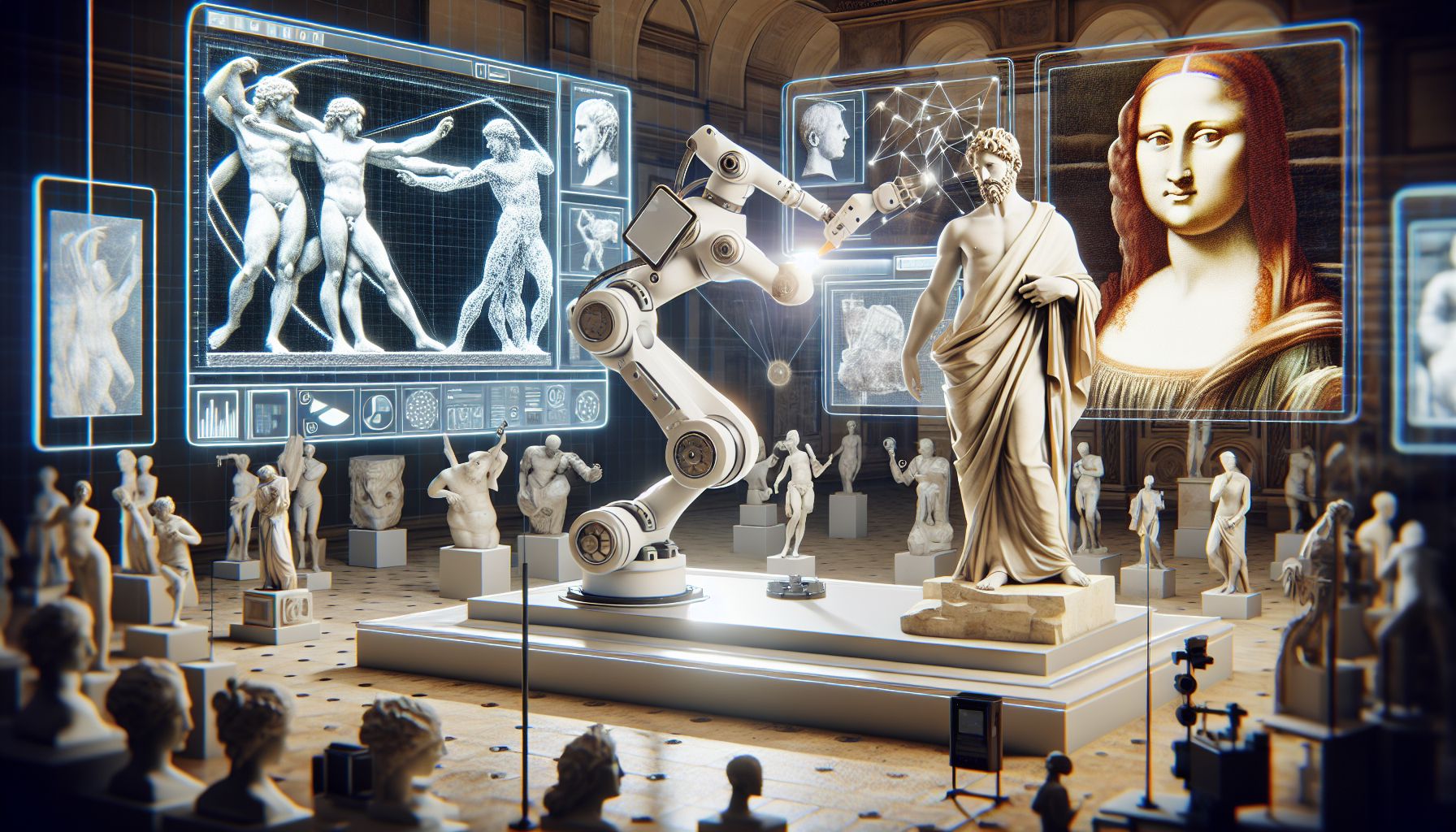
Hey tech lovers, it’s time to turn the spotlight onto one of the coolest crossovers happening right now—Artificial Intelligence in Creative Arts. Now, before you roll your eyes or imagine a legion of robotic Picassos crashing an art gallery, let me assure you that the reality is far more fascinating and, honestly, kind of mind-blowing. Grab a cup of coffee or your favorite brain-boosting beverage and let’s jump in!
The AI Renaissance: More Than Just Brushes and Paint
Picture this: you’re walking through a gallery where each canvas feels like it was made specifically for you. Artwork that somehow gets what you’re going through. Sounds like science fiction? Well, welcome to our weird new reality, brought to you by AI.
The Creation of a Machine Michelangelo
Let’s rewind to how this all started. AI’s first attempts at art were like watching a clumsy toddler with finger paints—lots of code-heavy experiments that produced pixelated nightmares that would make any art teacher cry. But those early disasters were just growing pains. Fast forward to now, and we’ve got AI models creating artwork that actually captures something that feels human. Companies like OpenAI have completely changed the game with machine learning models like DALL-E, which can create art just from you describing what you want. I can literally type “a melancholic robot sitting in a coffee shop” and boom—there’s my album cover.
Making Waves in Music
Art is just the beginning. Music isn’t safe from digital takeover either. We now have tools like Jukedeck and Amper Music that use AI to compose everything from orchestral pieces that’ll give you chills to pop hooks you can’t get out of your head. And here’s the weird part—these aren’t just robotic beeps and boops. We’re talking about songs written by algorithms that could honestly fool you into thinking Mozart came back from the dead.
Is AI in Tune with Human Musicians?
Will AI replace your favorite band? Not anytime soon. Making music involves messy human stuff like heartbreak, cultural references, and that indefinable spark that our silicon friends are still trying to crack. But they’re already showing up as creative partners, helping human musicians fill in gaps and explore new sounds. I wouldn’t be shocked if the next Billboard hit has some AI fingerprints on it.
Cinema Gets a Shot of AI
In Hollywood, AI is the backstage crew member nobody talks about but everyone relies on. Remember when animators had to hand-draw every single frame? AI laughs at that old-school approach. Deep learning can now pump out photorealistic CGI characters and entire worlds in a fraction of the time it used to take. Peter Jackson probably wishes he’d had this tech during the Lord of the Rings marathon.
AI Narratives: Storytelling through Neural Networks
Can AI write movie scripts? You bet. They’re not winning Oscars yet, but AI-generated scripts are getting surprisingly good. Companies like OpenAI and platforms like AI Dungeon are churning out stories from neural networks that are genuinely unpredictable. Sure, traditional Hollywood might turn up their noses, but there’s something refreshing about narratives that come from completely left field.
The Canvas of Concerns
Of course, it’s not all rainbows and unicorns. AI in art opens up a whole can of worms that makes my head hurt. Who actually owns a painting made by AI? How do you credit a computer? And what happens when AI gets so good at copying existing styles that you can’t tell what’s original anymore? These questions keep art lawyers up at night.
Art vs. Attribution
Here’s where things get really messy. AI systems learn by analyzing millions of existing artworks, essentially remixing everything they’ve seen. Copyright law is completely unprepared for this. If an AI creates something in Van Gogh’s style after studying thousands of his paintings, who gets the credit? The programmers? Van Gogh’s estate? The AI itself? We’re still figuring this out, but the old rules definitely don’t apply anymore.
A Glimpse into Tomorrow
Looking ahead, I can totally see entire art festivals dedicated to AI-generated work, or Grammy categories for human-AI collaborations. The line between who’s creating what is getting blurrier by the day.
As AI carves out its space in the creative world, it’s opening doors to types of expression we never imagined. For artists, musicians, filmmakers, and writers, we’re living in this strange time where our tools are becoming creative partners.
Honestly, working with AI in creative fields feels like being at a party where you’re never quite sure who’s leading the conversation, but somehow it keeps getting more interesting. So here’s to a future filled with digital brushstrokes and algorithmic poetry, as we figure out what art even means anymore.
Until next time, let’s keep mixing tech with creativity. Who knows—the next piece of art that stops you in your tracks might already be taking shape in some server farm. Have you created anything cool with AI? I’d love to hear about it!
Stay curious, stay creative.
Cheers!