The Changing Religious Landscape
American religious life is at a crossroads that reflects deeper questions about community, belonging, and shared meaning. The numbers tell a story of dramatic transformation: those claiming no religious affiliation have nearly doubled since 2007, rising from 16 percent to over 30 percent of US adults according to Pew Research religion data. This shift is more than statistical change. It’s a fundamental reckoning with how communities form, sustain themselves, and serve their members in an increasingly individualistic society.
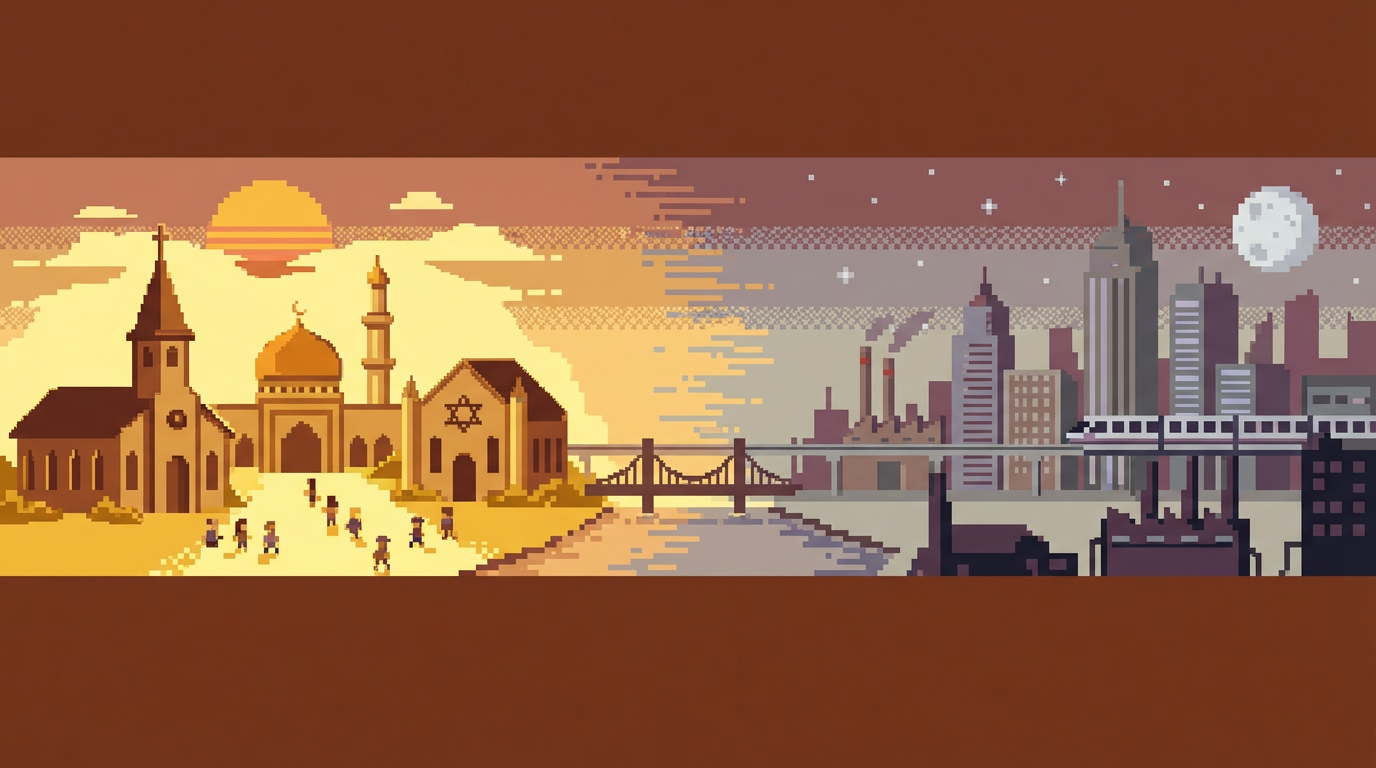
But within this apparent decline is a more complex reality. While traditional religious institutions face membership challenges, new forms of spiritual community are emerging. The fastest-growing category of religious self-identification is “spiritual but not religious,” suggesting that the human need for transcendence and community persists even as institutional forms evolve. This tension between declining traditional affiliation and persistent spiritual seeking creates both opportunity and uncertainty for faith communities trying to understand their role in contemporary American life.
The disagreement over religion’s future often centers on whether secularization is liberation from outdated institutions or the loss of irreplaceable social infrastructure. Both perspectives contain truth. The communities caught between them must navigate competing pressures while maintaining their core mission of serving human needs for connection, meaning, and mutual support.
The Infrastructure Question
Religious congregations have long provided social infrastructure that extends far beyond Sunday worship. They organize food pantries, host community meetings, provide childcare, offer grief support, and create spaces where neighbors can gather across economic and social lines. This infrastructure operates through relationships built over time, sustained by shared values, and motivated by commitments that transcend immediate self-interest.
Secular alternatives struggle to replicate this comprehensive social fabric. Community centers, civic organizations, and nonprofits can address specific needs, but they rarely offer the continuity, depth of relationship, and holistic approach that characterizes healthy religious communities. The disagreement here isn’t about the value of secular institutions, which clearly serve important functions, but about whether they can fully replace the particular kind of social cohesion that faith communities generate.
Critics argue that religious institutions can be exclusionary, judgmental, or resistant to social progress. These concerns have merit and help explain why many people seek community elsewhere. But dismissing religious institutions entirely ignores their demonstrated capacity to mobilize resources, sustain long-term commitments, and bridge social divisions in ways that purely secular organizations often cannot match. The challenge becomes how to preserve valuable social infrastructure while addressing legitimate concerns about inclusion and relevance.
Progressive Faith and Conservative Decline
The internal dynamics of religious change reveal another layer of complexity. While conservative denominations experience membership decline, progressive religious spaces show growth. This trend suggests that the issue isn’t simply religion versus secularism, but rather which forms of religious expression resonate with contemporary values and concerns. Progressive congregations often emphasize social justice, environmental stewardship, and inclusive community in ways that align with broader cultural shifts.
This development creates tension within religious communities themselves. Traditional believers may feel that progressive adaptations compromise essential theological commitments, while progressive religious people argue that faithfulness requires engagement with contemporary challenges and insights. The disagreement reflects deeper questions about whether religious traditions should primarily preserve ancient wisdom or actively adapt to new circumstances.
The growth of progressive religious spaces also challenges secular assumptions about religion’s inevitable decline. Rather than disappearing, religious communities may be evolving toward forms that better address contemporary spiritual and social needs. This evolution suggests that the future of religion in America will likely involve transformation rather than simple disappearance, creating opportunities for new kinds of dialogue between religious and secular communities.
Digital Community and Changing Practice
The COVID-19 pandemic accelerated experiments in digital religious community that reveal both possibilities and limitations of technology-mediated faith. Online worship services, virtual small groups, and digital pastoral care allowed congregations to maintain connection during isolation. Significantly, about 40 percent of people who joined online religious communities during the pandemic have continued participating, suggesting that digital formats meet real needs.
This shift raises fundamental questions about the nature of religious community. Can authentic spiritual relationships form through screens? Does physical presence matter for the kind of deep community that sustains people through life’s challenges? Different communities have reached different conclusions, with some embracing hybrid models while others insist on the irreplaceable value of in-person gathering.
The disagreement over digital religious community reflects broader tensions about technology’s role in human relationships. Some see digital tools as expanding access and creating new forms of authentic connection, while others worry about the loss of embodied presence and spontaneous encounter. Religious communities are testing grounds for these questions, with implications that extend far beyond houses of worship to include how all communities might sustain meaningful relationships in an increasingly digital world.
Interfaith Action and Shared Purpose
Despite declining individual religious affiliation, interfaith coalitions have become increasingly important in addressing community challenges. Religious organizations working across denominational lines lead significant efforts on housing affordability, immigration support, and poverty reduction. These collaborations demonstrate religion’s continued capacity to motivate public service and social change, even as traditional congregational models face pressure.
Interfaith cooperation often emerges from shared commitment to serving vulnerable populations rather than theological agreement. This pragmatic approach to religious collaboration suggests new models for faith community engagement that emphasize common action over doctrinal unity. Such partnerships can include secular organizations and individuals, creating broader coalitions that draw on religious communities’ organizational capacity while remaining open to diverse participants.
The success of interfaith social action challenges both religious and secular communities to reconsider their assumptions. Religious communities discover that cooperation across theological differences can strengthen rather than weaken their witness, while secular organizations learn that excluding religious partners may limit their effectiveness. These partnerships point toward more collaborative approaches to community problem-solving that honor different motivations while focusing on shared goals.
The conversation about religion’s place in secular society will continue evolving as communities experiment with new forms of spiritual expression, social organization, and collaborative action. Understanding these changes requires moving beyond simple narratives of religious decline or secular triumph to engage the complex ways that communities create meaning, sustain relationships, and serve human needs. Both religious and secular communities have valuable contributions to make in building the kind of society where all people can flourish. Resources like the Religion News Service provide ongoing coverage of these developments, helping communities stay informed about trends that affect us all. What forms of community do you find most meaningful, and how might different traditions learn from each other in creating spaces where people can connect, grow, and serve others?